


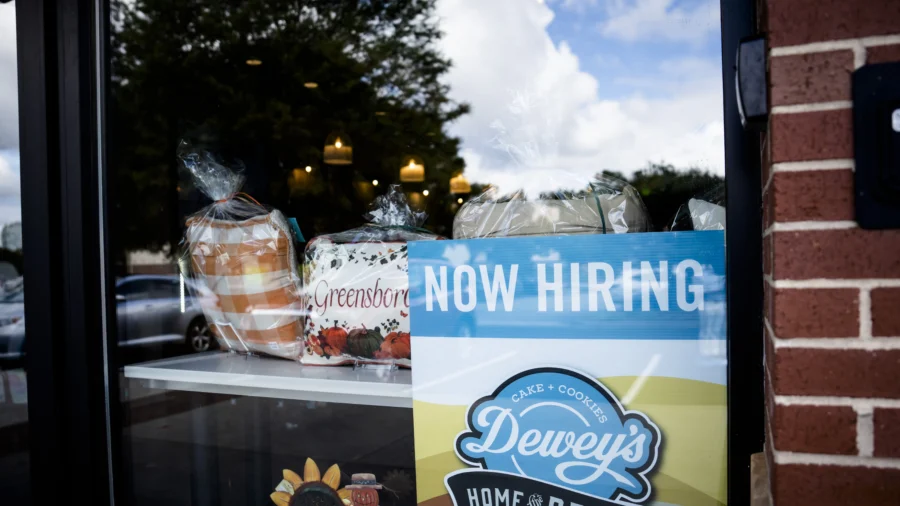
The number of Americans filing new applications for unemployment benefits rose to the highest level in two months last week.
This is up from the previous week's 224,000 and higher than the consensus estimate of 225,000. However, the increase was partly fueled by technical adjustments to account for seasonal fluctuations in employment throughout the summer months.
The four-week average—a measure that removes week-to-week volatility—rose to 226,250 from 221,750.
A key initial jobless claims program for federal workers held steady at 635. Economists are monitoring this metric to determine whether the administration's policies and the related actions by the Department of Government Efficiency are impacting government payrolls.
Continuing jobless claims—the number of unemployed individuals currently receiving benefits—surged to a higher-than-expected 1.97 million from a downwardly revised 1.94 million.
Recurring claims are at an almost four-year high and have remained above 1.9 million for 13 consecutive weeks.
Economists say that the high level of continuing jobless claims reflects the challenges workers face in finding employment opportunities, as companies have placed their staffing plans on hold.
A new RedBalloon-PublicSquare Freedom Economic Index shared with The Epoch Times found that 50 percent of surveyed employers are neither increasing nor reducing personnel levels.
However, this could change in the coming months, as small businesses have signaled greater optimism. The August survey highlighted that about half of the businesses plan to invest in new products, equipment, locations, or services "significantly" or "modestly."
Workers may not share the same positive outlook.
Additionally, individuals employed four months ago and still working at their positions clocked in at 87.1 percent, the lowest since July 2020.
At the same time, the labor market trajectory is "potentially troubling," and "there has been degradation, for sure," said Atlanta Fed President Raphael Bostic.
The Fed’s Focus
While monetary policymakers and economists observe potential red flags in the job market, new minutes from last month’s Federal Reserve policy meeting suggest that officials are more focused on the inflation side of the institution’s dual mandate rather than the labor market.
"Participants generally pointed to risks to both sides of the Committee's dual mandate, emphasizing upside risk to inflation and downside risk to employment," the document stated.
"A majority of participants judged the upside risk to inflation as the greater of these two risks, while several participants viewed the two risks as roughly balanced, and a couple of participants considered downside risk to employment the more salient risk."
Economists have noted that the meeting occurred two days before the Bureau of Labor Statistics released the July jobs report, which showed fewer jobs created than expected and a two-month downward revision of 258,000.
It is unclear how the Federal Reserve would have reacted if policymakers had these numbers available when deciding interest rates.
Eric Teal, CIO for Comerica Wealth Management, says the labor market continues to be a "wild card" but that frequent figures have "yet to substantiate the concerns created by the July jobs report."
"Inflation remains on the front burner for Fed officials as tariffs still pose a risk to the economy and a pickup in inflation," Teal said in a note emailed to The Epoch Times.
The next major inflation report will be the central bank's preferred personal consumption expenditures (PCE) price index for July.