


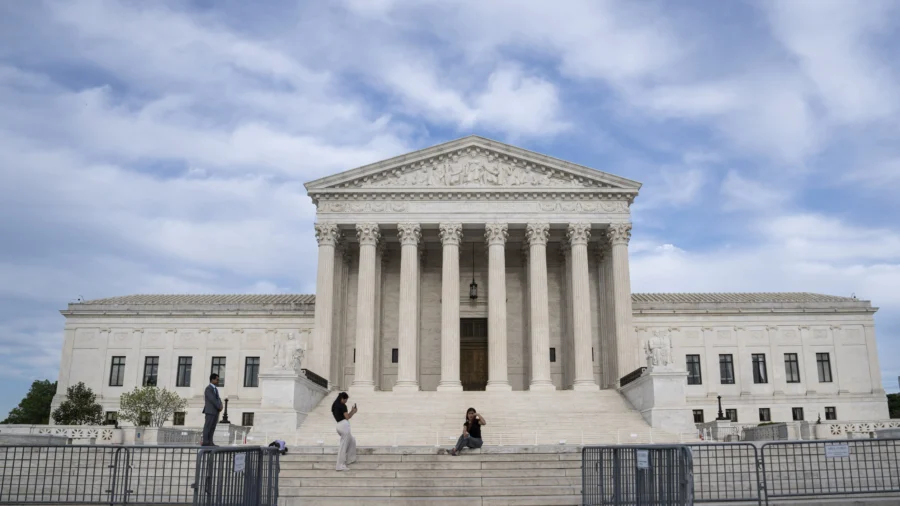
The U.S. Supreme Court on April 29 limited the use of race-based redistricting in a legal challenge to Louisiana’s congressional map.
The nation’s highest court ruled 6–3 in Louisiana v. Callais that race could not be used when drawing boundaries for the state's electoral districts.
The case rests on whether a lower court-ordered creation of a second black-majority congressional district in Louisiana was constitutional. A federal district judge had ordered the state to create the second district to comply with the antidiscrimination provisions of the 1965 federal Voting Rights Act.
Judge Shelly Dick of the U.S. District Court for the Middle District of Louisiana ruled that an earlier version of the state’s electoral map, which included only one black-majority congressional district, discriminated against black voters, who constitute almost one-third of the state’s population.
In other words, the judge found that Louisiana’s failure to add a second black-majority congressional district likely violated Section 2 of the Voting Rights Act.
Section 2 prohibits voting practices or procedures that discriminate based on race, color, or membership in a large language-minority group such as American Indian, Asian American, Alaskan Native, or American Hispanic.
Courts have held that the Voting Rights Act, in certain circumstances, allows states to take race into account when drawing electoral boundaries but that electoral maps drawn explicitly based on race are unconstitutional. The statute has been interpreted by the courts to forbid racial gerrymandering when it dilutes minority voting power.
In the Louisiana case, a group of non-black voters sued, arguing that the map with two black-majority districts discriminated against non-minorities by engaging “in explicit, racial segregation of voters.”
Later, a divided panel of federal judges in the Western District of Louisiana agreed with the non-black voters that the electoral map with two black-majority districts was an unconstitutional racial gerrymander that disfavored non-black voters. Gerrymandering is the manipulation of electoral district boundaries to favor a particular party or constituency.
“Section 2 of the Voting Rights Act of 1965 ... was designed to enforce the Constitution—not collide with it,” Alito wrote. “Unfortunately, lower courts have sometimes applied this Court’s [Section 2] precedents in a way that forces States to engage in the very race-based discrimination that the Constitution forbids.”
Compliance with Section 2 can “provide a compelling reason for race-based districting,” but the section “does not impose liability at odds with the Constitution, and it should not have imposed liability on Louisiana for its 2022 map,” he wrote.
Complying with the section “could not justify the State’s use of race-based redistricting here,” and even though the state made “understandable” efforts to comply with the district judge’s ruling, the redrawn map with a second black-majority congressional district was nonetheless “an unconstitutional racial gerrymander,” Alito said.
After that ruling was handed down, plaintiffs in voting discrimination lawsuits began “dressing their political-gerrymandering claims in racial garb,” he said.
“If race and politics are not disentangled and a [Section 2] claim is cynically used as a tool for advancing a partisan end, the [Voting Rights Act’s] noble goal will be perverted," he said.
Justice Clarence Thomas filed a concurring opinion, which was joined by Justice Neil Gorsuch, saying that the majority did not go far enough.
The court should never have ruled in Thornburg v. Gingles (1986) that Section 2 effectively gave racial groups “an entitlement to roughly proportional representation,” Thomas said.
That ruling, which was “repugnant to any nation that strives for the ideal of a color-blind Constitution,” led legislatures and courts to “systematically divide the country into electoral districts along racial lines.”
The April 29 decision should largely end this “disastrous misadventure in voting-rights jurisprudence,” he added.
The Supreme Court’s majority affirmed the judgment of the panel from the Western District of Louisiana.
Kagan filed a dissenting opinion, which Sotomayor and Jackson joined.
Kagan said the majority is using the Rucho decision as a “cudgel to diminish the rightful voting influence of its minority citizens.”
She said the majority claims that it is merely “updating” its interpretation of Section 2, but under its new view of the section, “a State can, without legal consequence, systematically dilute minority citizens’ voting power.”
Those so-called updates “eviscerate the law,” and the majority “formulates new proof requirements for plaintiffs alleging vote dilution.” Under this new ruling, and others, the majority has completed its “demolition of the Voting Rights Act,” she said.
Harmeet Dhillon, assistant U.S. attorney general for civil rights, hailed the majority opinion, saying that April 29 is a “big day in constitutional law.”
The Voting Rights Act “remains intact, but to protect Americans AGAINST discrimination rather than requiring it,” she wrote on X.
Louisiana Attorney General Liz Murrill said the Supreme Court “has ended Louisiana’s long-running nightmare of federal courts coercing the state to draw a racially discriminatory map.”
“That was always unconstitutional—and this is a seismic decision reaffirming equal protection under our nation’s laws,” she told The Epoch Times.
Matthew Forys, executive vice president of Landmark Legal Foundation, which filed a brief in the case, praised the ruling, which he said emphasizes that “American law cannot treat people differently on the basis of race.”
“The majority effectively threads the needle between the colorblindedness required by the Constitution and the need to continue policing racially discriminatory districting in federal court,” Forys told The Epoch Times.
Democratic National Committee Chairman Ken Martin criticized the ruling, saying that April 29 is “a dark day for America,” on which the court “rolled back the clock on the Civil Rights Movement.”
“The GOP-captured Supreme Court just effectively killed Section 2 of the Voting Rights Act, a major step back in the fight for racial justice and fair representation,” Martin said in a statement.
The Rev. Al Sharpton, president of the National Action Network, said the decision is “a bullet in the heart of the voting rights movement.”
“The Supreme Court has not just weakened a law, it has humiliated and dismantled the life’s work of Dr. Martin Luther King Jr., [former civil rights activist and congressman] John Lewis, and every man and woman who marched, bled, and died for Black Americans to have an equal voice at the ballot box,” Sharpton told The Epoch Times.