


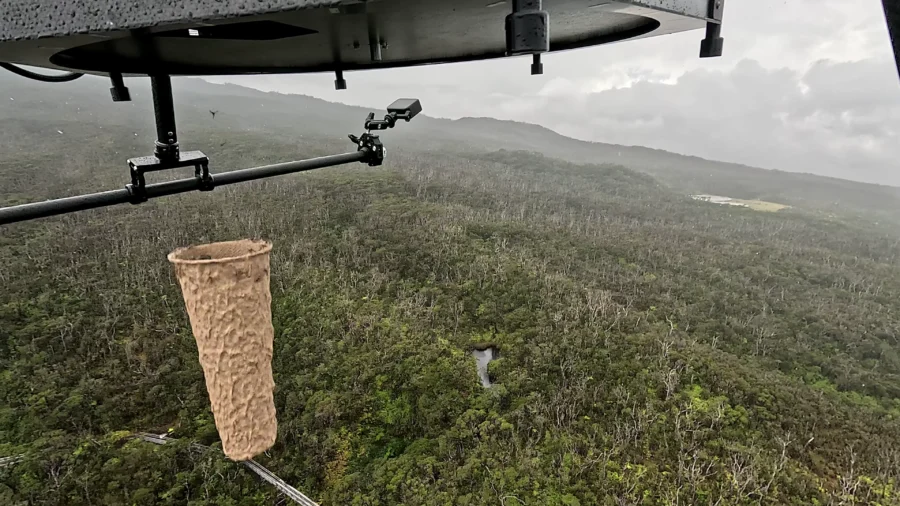
In the forests of Maui and Kaua‘i, drones are releasing thousands of lab-raised mosquitoes to help save Hawaii’s endangered native birds. Fortunately, these are not biting mosquitoes.
The insects are male and carry a naturally occurring bacteria called Wolbachia. When they mate with wild females, the resulting eggs don’t hatch, helping to shrink the mosquito population over time.
The effort is led by the Hawai‘i Department of Land and Natural Resources (DLNR) in collaboration with the “Birds, Not Mosquitoes” partnership, which includes federal agencies and conservation groups. Their goal is to suppress invasive mosquitoes that transmit avian malaria.
The suppression method is called the Incompatible Insect Technique, and has been used worldwide since the 1960s to combat diseases like dengue and yellow fever. In Hawaii, it was adapted specifically for the southern house mosquito. Male mosquitoes are bred in labs, infected with an incompatible strain of Wolbachia, and released into the wild to disrupt reproduction.
“With consecutive releases, mosquito populations decrease because no new generations are produced,” according to the project. “The decrease in mosquito populations means that there will be fewer mosquitoes that are able to transmit fatal avian malaria to our endangered honeycreepers.”
“It’s extremely exciting to have reached this project milestone,” said Adam Knox, who is the drone pilot and Aerial Deployment Project Manager with the ABC. “It took a lot of hard work and reliance on strong partnerships to reach the point where we could successfully demonstrate the utility and potential of drone aircraft as a tool for this important work, especially in one of the more challenging environments in the world. This opens up a lot of possibilities now and into the future," he said.
The terrain presents major challenges: steep elevations, dense forests, high winds, and frequent rain. The drone systems had to be tested under these conditions to ensure reliability and effectiveness.
Hawaii’s honeycreepers are among the world’s most threatened bird groups. Of over 50 original species, only 17 remain. Many of those remaining are endangered. The ‘akikiki is now functionally extinct in the wild, and fewer than 100 ʻakekeʻe survive on Kaua‘i.
“Without significantly reducing invasive mosquito populations, multiple native bird species will disappear forever in the near future,” said Dr. Chris Farmer, ABC’s Hawai‘i Program Director. ““At least 33 species of honeycreeper are now extinct, and many of the 17 that remain, including the Kiwikiu and ʻĀkohekohe on Maui, and ʻAkekeʻe on Kauaʻi, are highly endangered.”
“From a Native Hawaiian worldview, each native forest bird species is unique and precious,” DLNR stated. “Not only do they play an essential role in maintaining the native ecosystem, but they also factor prominently into several aspects of traditional Hawaiian customs, practices, and beliefs.”