


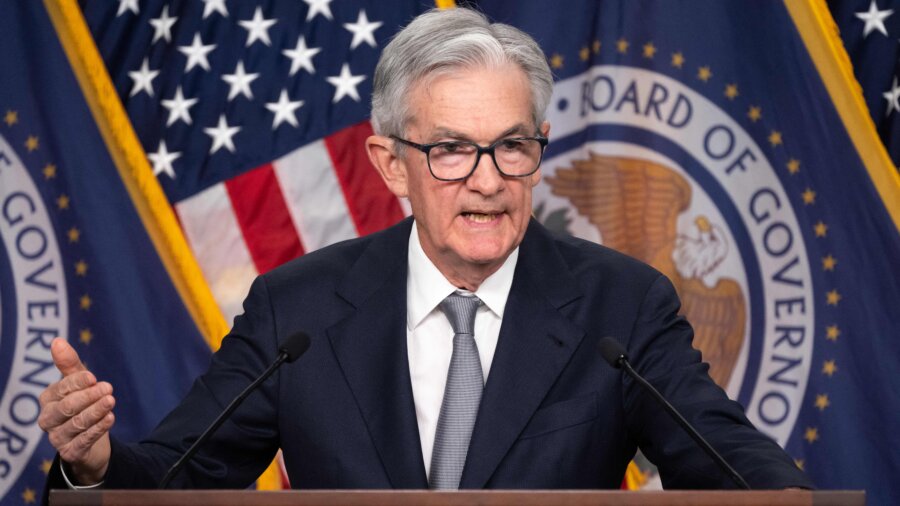
The Federal Reserve left interest rates unchanged at the November Federal Open Market Committee (FOMC) policy meeting, keeping in line with economists' expectations.
Central bank officials voted to keep the benchmark fed funds rate at a range of 5.25 percent and 5.50 percent.
Rate-setting Committee members are prepared to adjust monetary policy "as appropriate if risks emerge that could impede the attainment of the Committee's goals." The FOMC will take into account cumulative monetary tightening and the lags that can affect economic activity, inflation, and financial developments.
According to the FOMC, the U.S. economy expanded at a robust pace in the third quarter. While employment gains have moderated since the beginning of the year, the labor market remains strong. Inflation remains elevated and the banking system "is sound and resilient."
Fed Rate Outlook
The new consensus between the Federal Reserve and the financial markets is that interest rates will be higher for longer.The latest results showed a majority (57 percent) of respondents anticipating the Fed will keep rates in the same 5.25 percent and 5.5 percent range until September 2024. This past summer, they had projected rate cuts at the start of next year.
However, there is a divergence between the SEP data and survey figures. While central bank officials think the median policy rate will be above 5 percent next year, survey participants forecast 4.6 percent by the end of 2024.
About That Recession
Recession forecasts are not as fierce as they were a year ago.The CNBC Fed Survey showed a 49 percent probability of a recession in the next 12 months. The odds of a soft landing—a Goldilocks scenario of low inflation, a solid labor market, and economic growth—clocked in at 42 percent.
A National Association of Business Economists (NABE) survey shows most respondents think the U.S. economy will avoid a recession in the next 12 months. Fewer than a fifth (18 percent) believe a downturn is likely.
But Nick Galluccio, a portfolio manager at Teton Advisors, envisions a recession next year.
"By the middle of next year, you'll have some recession, a couple of quarters of negative GDP growth," Mr. Galluccio said in a note, adding that this would be a catalyst for the Fed to begin thinking about easing policy.
Bill Gross, the so-called bong king and former CIO of Pacific Investment Management Co. (PIMCO), anticipates a recession beginning in the fourth quarter.
The LEI slid by 0.7 percent in September, bringing the six-month average to negative 3.4 percent.
"So far, the U.S. economy has shown considerable resilience despite pressures from rising interest rates and high inflation," said Justyna Zabinska-La Monica, the senior manager of business cycle indicators at The Conference Board, in the report. "Nonetheless, The Conference Board forecasts that this trend will not be sustained for much longer, and a shallow recession is likely in the first half of 2024.”
While it is still early, various estimates point to modest growth in the October-to-December period.