


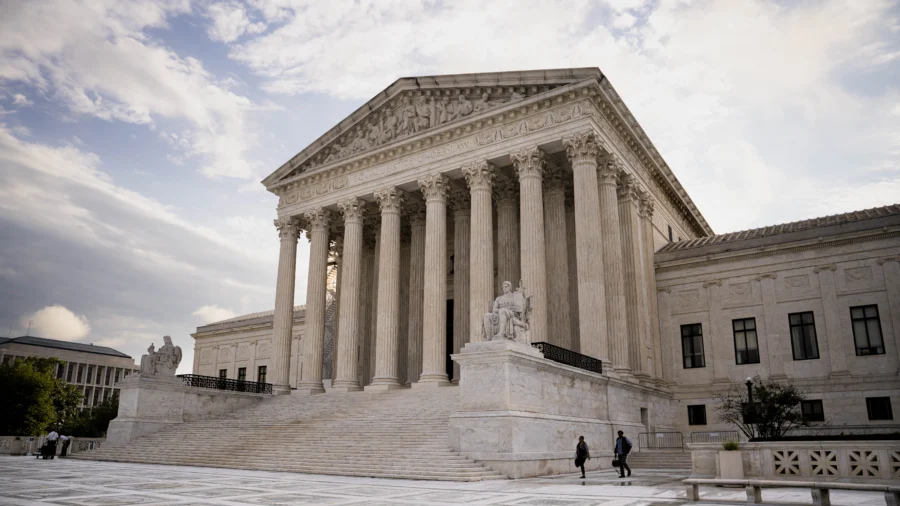
The U.S. Supreme Court will hear arguments Nov. 7 in United States v. Rahimi. People on both sides of the Second Amendment debate expect this to be a landmark test of the limits of the June 2022 decision in New York State Rifle and Pistol Association v. Bruen, which fundamentally changed how courts view gun control laws.
In Rahimi, the court will decide whether 18 USC 922 (g) (8), a federal law that disarms persons subject to a domestic violence protection order, is still valid.
The law has been deemed constitutional since it was enacted in 1994. The Bruen decision cast that in doubt.
In Bruen, gun owners challenged New York’s two-step means test—the person’s reason for wanting to carry a gun and their actual need— to determine if a person could legally carry.
The Supreme Court’s majority opinion, written by Justice Clarence Thomas, ruled that only the plain text of the Constitution and the laws in effect at the time of the amendment’s ratification could be considered.
Gun rights activists say the case is about prioritizing U.S. Constitutional rights. They say there are ways to deal with violent people without preemptively suspending constitutional rights.
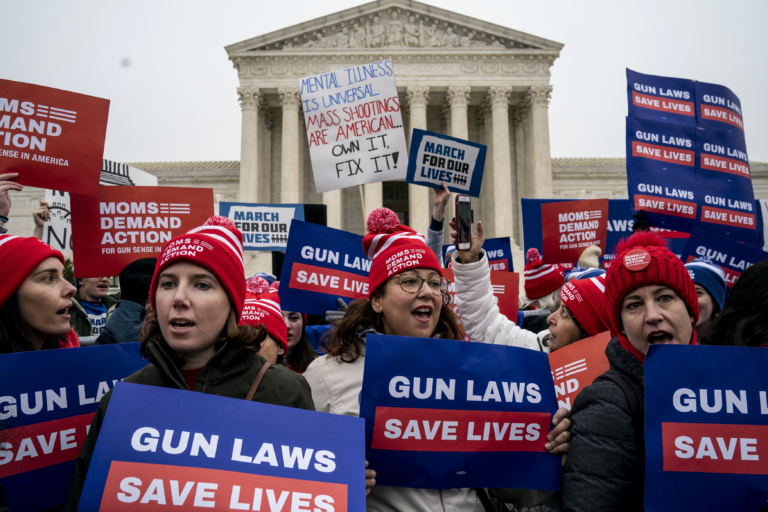
“The Supreme Court must reverse this dangerous ruling. Domestic abusers do not have—and should not have—the constitutional right to possess a firearm,” Janet Carter, Senior Director of Issues and Appeals at Everytown Law, wrote on the Everytown for Gun Safety website.
In this case, there is one thing on which both sides agree.
“I don’t want to be Zackey Rahimi’s neighbor. I don’t want Zackey Rahimi walking around armed,” Edward Paltzik, of the National Constitutional Law Union and an attorney for the Second Amendment Foundation told The Epoch Times.
Mr. Rahimi is an Arlington, Texas, drug dealer who abused his girlfriend and had a penchant for shooting at people who made him angry, according to court documents.
In 2019, his girlfriend petitioned the court and won a domestic violence restraining order against him under 18 USC 922 (g) (8). That federal law bars anyone subject to such an order from possessing or purchasing firearms.
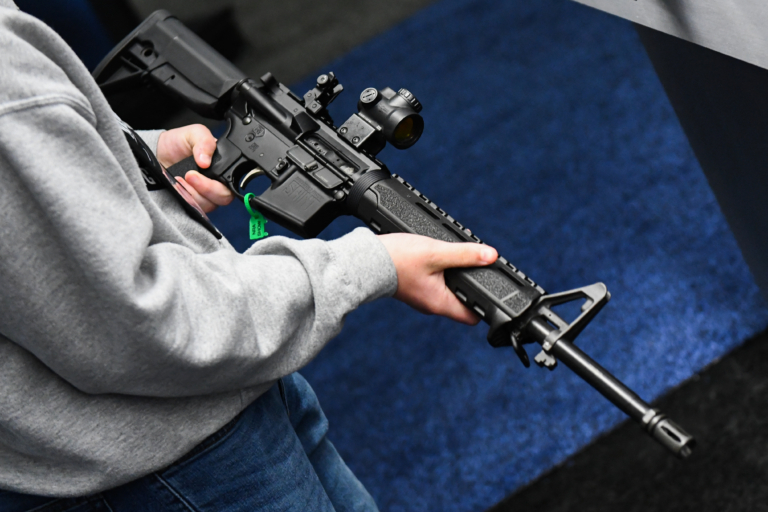
Mr. Rahimi was indicted by a federal grand jury in the United States District Court for the Northern District of Texas after police found guns, drugs, and cash in his home.
He appealed to the Court of Appeals for the Fifth Circuit to have the indictment struck down, claiming the restraining order violated the Second Amendment because it was issued before he had been convicted of any crimes.
The Fifth Circuit Court, which covers Texas, Louisiana, and Mississippi, upheld the indictment, and Rahimi pleaded guilty. He was sentenced to 73 months in prison.
Then came Bruen.
The Bruen decision changed the Fifth Circuit ruling in Rahimi’s case while it was in process, according to a petition filed with the Supreme Court by the Department of Justice (DOJ).
“But after [the U.S. Supreme Court] decided New York State Rifle & Pistol Association v. Bruen, the Fifth Circuit withdrew its opinion (upholding the indictment). After receiving supplemental briefing on Bruen, the court reversed,” the DOJ petition reads.
The Fifth Circuit ruled that, under the Bruen standard, 18 USC 922 (g) (8) did not align with the text of the Second Amendment and that there was no historical analog to indicate the law was in line with America’s history and tradition of firearms regulation. The court ruled that Rahimi had been deprived of his Second Amendment rights.
The DOJ asked the Supreme Court to hear its appeal. As the high court prepares to hear the arguments, there is one thing on which both sides in the Rahimi case agree.
The Bruen opinion marked a sea change in how the courts view gun rights in America.

In its petition, the DOJ points out several times in history when the United States prohibited people it considered dangerous from accessing firearms.
They pointed to post-revolutionary war laws that prohibited firearms ownership by those who refused to swear an oath of allegiance to the United States. In addition, several states had laws meant to prevent crime, the government claims.
“Colonial and early state legislatures likewise disarmed individuals who ‘posed a potential danger’ to others,” the government’s petition reads.
Laws Disarm Those ‘Who Pose a Danger’
“Those statutes show that individuals who were ‘reasonably accused of intending to injure another or breach the peace’ could properly be subject to firearm restrictions that did not apply to others,” the DOJ petition reads.“Or as one early scholar wrote, the government may properly restrict a person’s right to carry firearms when there is ‘just reason to fear that he purposes to make an unlawful use of them.’”
The government claims the founders meant to protect the law-abiding citizen’s right to keep and bear arms. According to the DOJ position, Bruen was built on a legal foundation laid in the 2008 District of Columbia v. Heller decision.
In that case, the court ruled that the Second Amendment protected the individual’s right to keep and bear arms.
“In keeping with that history, this Court explained in Heller that the right to keep and bear arms belongs only to ‘law-abiding, responsible citizens.’ And in Bruen, the Court stated that the Second Amendment protects the right of ‘an ordinary, law-abiding citizen’ to possess and carry arms for self-defense,” the DOJ’s petition reads.

But the Bruen decision appears to follow the reasoning being pushed by the gun rights advocates.
According to the Bruen decision, “When a challenged regulation addresses a general societal problem that has persisted since the 18th century, the lack of a distinctly similar historical regulation … is relevant evidence that the challenged regulation is inconsistent with the Second Amendment.
“Likewise, if earlier generations addressed the societal problem, but did so through materially different means, that also could be evidence that a modern regulation is unconstitutional.”
Mr. Smith points out that domestic violence is not a new problem. He contends it has traditionally been addressed by locking up, rather than disarming, offenders.
“It goes back to kind of the old saying that if you are literally too dangerous to be out on the street with a gun, then arguably you’re too dangerous to be on the street, period. So why aren’t we locking up people?” he asked.
Rahimi Is a Modern Issue
“It was only in the 20th century where you saw this modern assembly line of these civil restraining orders confiscating people’s firearms. So, under the Bruen test, domestic violence restraining orders fail, and red flag warrants also fail,” he said.One Second Amendment lawyer says the DOJ may have a point regarding America’s history of disarming citizens. He said addressing the issue would entail facing some harsh realities.
“One of the richest traditions we have in this country actually is stripping firearm rights from classes of individuals that we deem to be dangerous,” William Kirk, a lawyer with the Washington-state based, Washington Gun Law, told The Epoch Times.
“Now, unfortunately, this has to pull the scab off one of the other universal truths about civilian disarmament legislation; its inception is all based in racism.”
He pointed out that most early firearms prohibitions would violate modern civil rights laws. The bans, based on race, were meant to keep slaves from revolting, or they targeted groups for their religious or political beliefs. According to Mr. Kirk, there’s no reason to believe similar things can’t happen in today’s politically charged environment.
Due Process Must Be Required
The law that disarmed Mr. Rahimi is a federal law and provided him an opportunity to be heard in court. Many state-level red flag and extreme risk protection laws do not contain that protection.Like his fellow Second Amendment lawyers, Mr. Kirk believes 18 USC 922 (g) (8) is unconstitutional and should be struck down. But he said if the court considers history, that may not happen.
“The way we were going about determining who were dangerous classes of individuals was repugnant. But the concept that we as a society have accepted, removing firearms rights from people who are in fact dangerous, well, that’s existed since about 1640,” Mr. Kirk said.